
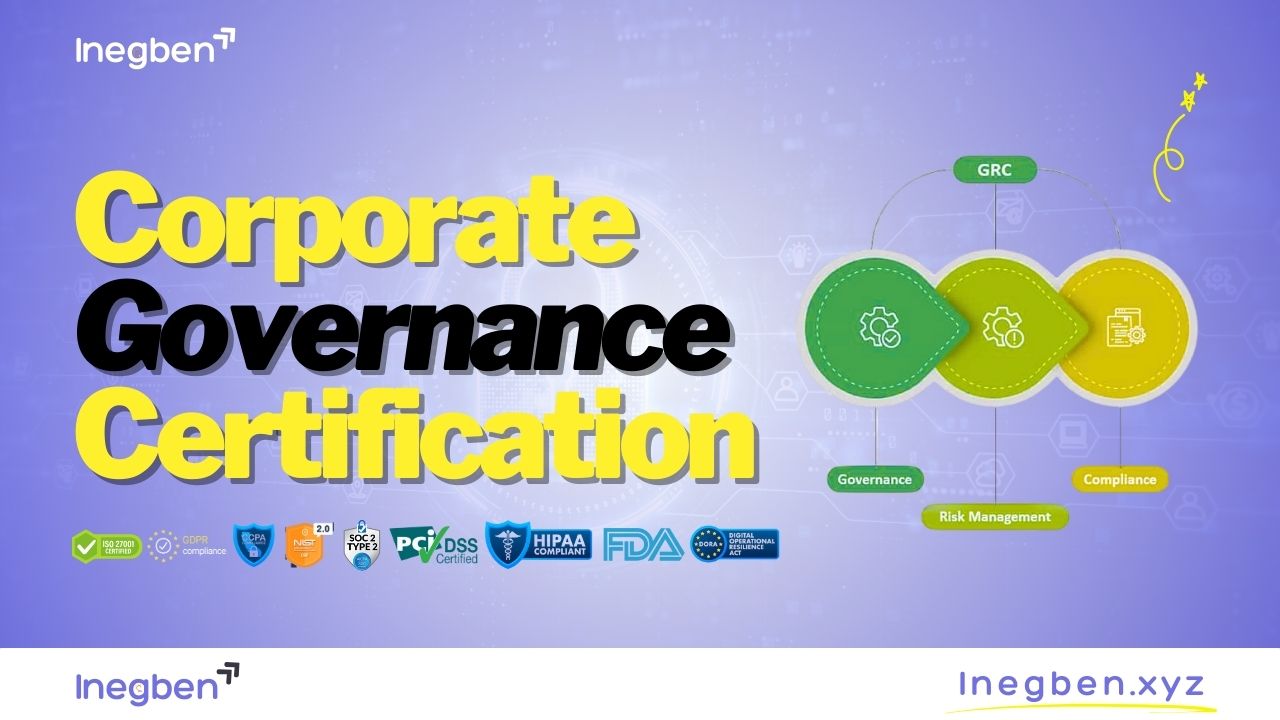
Corporate governance certification is a major part of our global compliance training here at Inegben Academy.
Corporate governance stands at a critical juncture in the history of global commerce.
As organizations transition from the traditional frameworks of the industrial age into the highly volatile and technologically complex “Intelligent Age,” the definition of corporate success is being fundamentally redefined.
At Inegben Compliance, the preeminent authority on cybersecurity and global regulatory standards, corporate governance is no longer viewed as a peripheral compliance obligation but as the essential operating system of the modern enterprise.
The rapid proliferation of artificial intelligence, the decentralization of data ecosystems, and the emergence of autonomous agentic systems have rendered legacy oversight models obsolete.
To remain competitive, organizations must move beyond reactive compliance and toward a model of proactive, anticipatory governance.
This transition requires a workforce that is not only theoretically grounded in risk management but practically proficient in the deployment of integrated GRC frameworks.
The Genesis of Governance: From the Industrial Revolution to the Digital Threshold
To understand the current “AI reckoning” facing corporate boards, it is necessary to analyze the historical trajectory of governance.
The industrial age established the foundational concepts of ownership and control, which were necessitated by the rise of large-scale capital investments.
In the 18th and 19th centuries, the separation of ownership from management became a defining characteristic of the corporation, leading to the early mechanisms of oversight found in merchant guilds and state-sponsored enterprises.
During this era, governance focused primarily on protecting shareholders from managerial self-interest through rudimentary legal constraints and the introduction of limited liability.
The “Gilded Age” and the subsequent 20th-century expansion introduced a new layer of complexity. As firms moved through horizontal and vertical integration, the role of the corporate manager became centralized, facilitating the flow of raw materials through production and distribution.
However, this period was also characterized by boards that were often described as “asleep at the wheel,” largely deferring to management as long as performance metrics remained high.
It was not until the 1970s that the modern iteration of corporate governance emerged in response to large-scale business scandals and the realization that the legal models of the time bore little relation to the practical reality of “corporate autocracy”.
| Historical Era | Governance Focus | Primary Challenge | Oversight Mechanism |
| Early Industrial | Shareholder Protection | Separation of Ownership/Control | Basic Legal Charters |
| Gilded Age | Production Efficiency | Monopolistic Consolidation | Hierarchical Management |
| Post-1930s | Market Regulation | Information Asymmetry | SEC Compliance (USA) |
| Modern Era (1970s+) | Board Accountability | Managerial Self-Interest | Audits, Committees, Codes |
| Intelligent Age | Algorithmic Ethics | AI Autonomy & Complexity | Integrated GRC & Real-time Data |
The AI Reckoning: Redefining Corporate Governance for the 21st Century

The current epoch represents a “mass disruption” in the corporate world, similar to recurring episodes of species extinction in biological history.
Since the year 2000, over 50 percent of Fortune 500 companies have been acquired, merged, or declared bankruptcy, often due to an inability to adapt to digital shifts.
In the Intelligent Age, the stakes are higher than ever. AI is not merely a tool for efficiency; it is a catalyst that fundamentally alters the competitive dynamics of every sector.
The Imperative of AI Fluency
Research indicates a stark performance gap between organizations that prioritize digital-era governance and those that do not.
Organizations with digitally and AI-savvy boards outperform their industry peers by 10.9 percentage points in return on equity. Despite this, as of late 2024, only 39 percent of Fortune 100 companies had disclosed any form of board oversight specifically for AI.A
At Inegben Compliance, we argue that AI fluency is a fiduciary responsibility. Boards must transition from being “passive reviewers” of technology to “active catalysts” who can bridge business problems with the transformative possibilities of AI.
This evolution requires boards to adopt one of four AI postures: Business Pioneers, Internal Transformers, Functional Reinventors, or Pragmatic Adopters.
Each posture requires a different degree of oversight. For instance, Business Pioneers require directors with deep technical expertise to act as credible challengers to management, while Internal Transformers must focus on ensuring that operational gains are structural and not merely transient.
From Tangible Assets to Algorithmic Values
The shift from the industrial age to the digital age is defined by the migration of value from factories to algorithms.
Traditional governance models, designed for linear hierarchies and tangible assets, struggle to manage the opaque and autonomous nature of modern decision systems.
Algorithms now make hiring decisions, trade billions in assets, and predict consumer behavior, often with minimal human oversight.
Governance frameworks must now extend to include digital accountability, algorithmic ethics, and technological transparency. This involves the concept of “encapsulated trust,” where the relationship between human stewards and their AI counterparts is redefined to ensure the effectiveness and humanity of business decisions.
Data is no longer just a byproduct of operations; it is a strategic asset and a potential liability that requires rigorous stewardship.
Boards must ensure that data usage aligns with brand values and that AI systems are free from the biases that perpetuate historical inequalities.
The Strategic Anatomy of Corporate Failure: A Warning for Modern Boards

The history of corporate failure provides a visceral lesson in the necessity of robust governance and GRC training. At its core, every major scandal of the 21st century can be traced back to a breakdown in oversight, a culture of silence, or the prioritization of short-term profit over ethical resilience.
Case Studies in Governance Deficiency
The collapse of industry giants offers a roadmap of what to avoid. Inegben Compliance emphasizes that these failures are rarely the result of a single error but are the cumulative effect of systemic governance decay.
- Boeing: The Erosion of Safety Culture: Once the pinnacle of engineering excellence, Boeing’s reputation was shattered following a series of fatal crashes and in-flight failures. The root cause was a failure in compliance and oversight, where the board failed to hold management accountable for a deterioration in safety standards, leading to a 32 percent drop in share price in 2024. The DOJ eventually judged that the company had failed to implement an effective compliance and ethics program, leading to massive fines and production halts.
- TD Bank: The Cost of Underfunding Compliance: Regulators fined TD Bank nearly $3.1 billion for allowing money laundering schemes to funnel hundreds of millions in “dirty money” through its network. The failure was attributed to corporate leadership’s chronic underfunding of the anti-money laundering (AML) program, which caused the system to atrophy while the bank prioritized growth and convenience over its legal obligations.
- FTX and Byju’s: The Myth of Unregulated Growth: The collapse of FTX and the value erosion at Byju’s serve as warnings against opaque management structures and a resistance to external oversight. FTX continued to raise capital despite a total lack of internal controls and a resistance to appointing external directors. These cases highlight that investors and boards must conduct much more thorough due diligence into a company’s governance practices to protect long-term value.
- Enron: The Legacy of Greed and Mismanagement: The collapse of Enron remains the textbook example of how aggressive accounting tactics and a total lack of board oversight can lead to the largest bankruptcy in history. The board’s failure to recognize “mark-to-market” fraud and their willingness to sign off on unexamined strategies demonstrated the “old idea” of a director being pliable and supportive rather than questioning and independent.
The Role of GRC in Organizational Resilience
To prevent such failures, successful corporations must implement an integrated GRC framework. GRC is not just a safety net; it is a strategic roadmap that ensures a business stays on course. By unifying governance, risk management, and compliance into a single coordinated strategy, organizations avoid the ad-hoc decision-making and scattered documentation that increase exposure.
A mature GRC program delivers significant operational benefits, including reduced audit effort, faster sales cycles, and improved risk visibility.
For example, companies with mature GRC systems can provide security documentation on-demand, reducing friction in contract negotiations and speeding revenue generation.
Furthermore, an integrated approach eliminates duplicated work by mapping overlapping requirements into a single control framework, allowing teams to satisfy multiple audits using shared evidence.
Positioning Corporate Governance Training as a Core Business Function

Inegben Compliance advocates for a comprehensive approach to training the compliance team. In the AI era, compliance is no longer a “back-office” function; it is a front-line defense and a driver of enterprise value.
The Business Case for Compliance Transformation
Training the compliance team in modern corporate governance is a strategic investment with measurable returns. The ROI of GRC training is found in the reduction of regulatory fines, the avoidance of reputational damage, and the optimization of business processes.
- Risk Anticipation vs. Reaction: Traditional models focus on risk avoidance, but modern governance focuses on risk anticipation. Trained teams can identify emerging digital threats early, allowing for proactive mitigation rather than reactive crisis management.
- Efficiency through Symbiosis: Modern GRC training teaches compliance teams how to use technology to strengthen governance. This includes using AI for audits to detect anomalies and blockchain to create immutable records of transactions.
- Fiduciary Responsibility: Modern governance requires a move “from compliance to conscience”. Training empowers teams to ensure that digital innovation aligns with long-term societal value, protecting the organization’s moral leadership.
- Investor Confidence and ESG: By 2030, ESG ratings are expected to incorporate digital-ethics indicators. Organizations with trained teams can demonstrate the transparent, responsible technology management that investors reward.
Key Metrics for Measuring Governance Training Success
To justify the investment in GRC training, organizations must track metrics that link learning to behavior and business outcomes.
| Metric Category | Specific KPI | Business Significance |
| Operational Speed | Mean Time to Issue Discovery | Measures how quickly the program identifies compliance issues. |
| Resolution Efficiency | Mean Time to Issue Resolution | Indicates how effectively the team addresses discovered problems. |
| Financial Impact | Compliance Expense Per Issue | Helps management understand the cost of resolving different types of misconduct. |
| Strategic Alignment | Training-Audit Correlation | Proves whether learning is resulting in fewer nonconformities during audits. |
| Engagement | Scenario Performance Scores | Moves beyond “checkbox” completions to measure mastery of complex challenges. |
The Inegben Global Practical GRC Training and Certification: A Detailed Roadmap for Enthusiasts
For those seeking to enter or pivot into the GRC field, Inegben Compliance Academy offers the most comprehensive, practically-oriented curriculum in the industry.
The “Inegben Global Practical GRC Training and Certification” is designed to move students from a nascent understanding of compliance to an expert-level proficiency in integrated GRC strategies.
Understanding the GRC Landscape Before You Pivot
For individuals considering a career change, it is essential to understand the foundational logic of the field. GRC is an “umbrella” over an organization’s security posture, encompassing rules, uncertainties, and obligations.
- Governance: The organization’s “rulebook” that determines who decides what and who is accountable.
- Risk: The identification of uncertainties that could impact business objectives.
- Compliance: The act of meeting obligations, including laws, standards, and internal policies.
The most critical takeaway for any aspiring professional is the role of the “translator.” A GRC professional must be able to explain complex technical risks (such as a 50-character password policy) in a way that management understands (business risk) and employees can follow (usability).
To gain a thorough understanding of this pivot, enthusiasts are encouraged to watch the foundational session below.
Navigating the Inegben Curriculum: A Step-by-Step Guide
The Inegben roadmap is a 6-month journey of intensive, practical learning. It is structured into specialized modules that align with the needs of modern corporations.
Phase 1: Onboarding and Fundamentals
The journey begins with a compulsory live onboarding and platform walkthrough to ensure every student is set up for success.
- Module 1-2: Regulatory Environment: An introduction to the foundational principles of GRC and the global regulatory bodies that shape the industry.
- Module 3: Compliance in Organizations: Focuses on the practical aspects of compliance within financial institutions and general business environments.
Phase 2: Risk and Structure
This phase builds the technical and strategic muscle required for high-level oversight.
- Module 4: Risk Management Principles: A deep dive into cybersecurity risk management, identifying, calculating, and communicating uncertainties.
- Module 5: Financial Crimes and Compliance: Explores risk indicators for banks and the technology used to combat financial crime.
- Module 6: Corporate Governance Structures: Reimagining governance for risk oversight in the modern age.
Phase 3: Practical Application and Case Studies (The Core)
The heart of the program is Module 8, which contains 22 lessons focused on hands-on application.
- Policy Building: Writing information security policies, ransomware protection plans, and asset management protocols.
- Framework Implementation: Practical guides for the NIST Cybersecurity Framework and ISO standards (ISO 27001:2022 and ISO 22301).
- Specialized Techniques: Threat intelligence programs, vendor management, and risk assessment techniques.
Phase 4: Advanced AI and Technical Training
Recognizing the shift toward the Intelligent Age, Inegben incorporates specific modules for future-proofing.
- Module 9: AI and GRC: Balancing innovation and risk through AI “co-pilots” and agents for GRC programs.
- Module 10: ServiceNow GRC: Technical training on the industry’s leading GRC software, covering control objectives, entity scoping, and the control lifecycle.
Phase 5: Task and Certification
The program concludes with a pre-project assessment brief, a specific AI and GRC assignment, and the final round-up for certification.26 Successful graduates are celebrated in an 8th-week ceremony, signifying their entry into the top 1% of the GRC career path.
The Convergence of Compliance and Technology: AI for GRC
In the AI era, the relationship between governance and technology is reciprocal. While governance must oversee AI, AI is also a powerful tool for enhancing governance.
Leveraging AI for Governance Efficiency
Effective governance is delivered through corporate instructions, staff, processes, and systems. AI tools can strengthen this by providing real-time oversight and standardizing processes.
- Process Automation: AI automates repetitive tasks like preparing board materials and tracking compliance deadlines, freeing up professionals to focus on higher-value tasks like strategy and board relations.
- Risk Detection: AI can monitor vast amounts of internal and external data to detect early warning signs of financial irregularities or reputational threats.
- Provenance and Metadata: By recording the metadata of data’s source, AI provides historical context that supports auditing and leads to more accurate, trustworthy outputs.
Addressing the Risks of AI in Governance
However, the integration of AI into governance is not without risk. AI systems lack the human judgment and context required for many sensitive environments. If trained on biased datasets, AI can make discriminatory judgments, leading to legal and reputational issues.
At Inegben GRC Compliance Training, we emphasize that “human-in-the-loop” processes are non-negotiable. Critical decisions, such as regulatory reporting, risk acceptances, or enforcement actions, must remain under human supervision.
Furthermore, organizations must implement “explainability ratios” to ensure that AI decisions are linked to clear metadata lineage, providing transparency and accountability.
Maturation of the Corporate OS: A Strategic Framework for Boards
For a corporation to succeed in the Intelligent Age, its governance maturity must evolve. GRC maturity is not about bureaucracy; it is the “operating system for sustainable innovation”.
The Five Stages of AI Governance Maturity
Organizations must benchmark their current state to identify capability gaps and align AI plans with business needs.
| Maturity Stage | Characteristics | Primary Focus |
| Nascent/Ad Hoc | Informal, reactive, and fragmented practices | Awareness and basic risk identification |
| Developing/Defined | Policies and roles are documented but inconsistent | Policy creation and role definition |
| Mature/Operationalized | Governance is embedded into data and model pipelines | Automation, monitoring, and lineage |
| Transformative/Leader | AI is a core competitive advantage with predictive control | Scaled innovation and agility with assurance |
| Visionary/Leading | Governance culture is synonymous with organizational culture | Continuous, real-time optimization |
Actionable Actions for Board Oversight of AI
To reach the higher stages of maturity, boards must take six specific actions as outlined by global research leaders:
- Align on AI Posture: Review the company’s stance on AI annually to ensure it reflects current realities.
- Clarify Ownership: Define which AI topics belong in full-board sessions and which belong in specialized committees.
- Codify Policy: Establish board-approved structured AI policies that specify scaling rules, risk thresholds, and vendor guardrails.
- Engage Directly with Implementers: Bypass traditional hierarchies to interact with the executives embedding AI into operations.
- Tie Investment to Value: Require management to quantify the potential opportunities and risks of AI adoption.
- Focus on Resilience: Probe for observability and explainability to ensure AI systems are trackable and correctable.
Standardizing Trust: The Global Perspective
As corporations operate in an increasingly interconnected world, governance can no longer be purely local. Fragmented development of AI regulations creates a “trust gap” that taxes global growth.
The Move Toward Global AI Governance
The dawn of the Intelligent Age requires a new global architecture based on cooperation. Organizations should look toward international standards like ISO/IEC 42001:2023, which provides a robust operational blueprint for embedding ethics and security into AI processes. These standards do not create requirements from scratch but harmonize leading practices to ensure cross-border interoperability and the mitigation of systemic risk.
The goal of this global coordination is not control, but “continuity”. By aligning on foundational principles such as safety and human dignity, while respecting cultural diversity in implementation, the global community can turn governance into a flywheel for shared prosperity.
The Philosophy of Inegben Compliance: Excellence as a Standard
At Inegben Academy, our philosophy is rooted in the belief that GRC professionals are the “guardians of trust”. The academy received a shocking number of applications but prioritizes quality over quantity, closing windows early to maintain an environment where only the “best of the best” graduate.
Holistic Training for Future Leaders
Beyond the technicalities of GRC, Inegben provides training in portfolio building, LinkedIn optimization, and job hunting strategies. This ensures that our graduates are not only technically proficient but capable of navigating the global digital economy as leaders.
We align our curriculum with international benchmarks, including Harvard-level frameworks, to ensure that our students are in the top 1 percent of their career paths.
The program is strict because the role of a GRC professional is high-stakes. A failure in this role can lead to financial penalties, business discontinuity, and the destruction of a professional’s career.
Therefore, we demand a high level of inquiry, analytical thinking, and commitment from our students.
Conclusion: The New Compass for Corporate Success
The transition from the industrial age to the Intelligent Age has transformed corporate governance from a back-office necessity into a strategic differentiator. Success in the modern era is predicated on an organization’s ability to navigate the “AI reckoning” with fluency, ethics, and resilience.
At Inegben Compliance Training, we believe that the integration of a robust GRC framework, supported by a practically-trained compliance team, is the only way to safeguard stakeholder trust and long-term value.
For the GRC enthusiast, the roadmap is clear: begin with a solid understanding of the “rulebook,” pivot with a translator’s mindset, and master the practical implementation of global standards through the Inegben Global Practical GRC Training and Certification.
For the corporation, the mandate is equally urgent: train your teams, automate your controls, and position governance as the core of your strategic vision.
In the new era of intelligent machines, it is the organizations with the strongest moral and structural compass that will not only survive but redefine the future of global commerce.
The Intelligent Age belongs to those who govern it responsibly.